
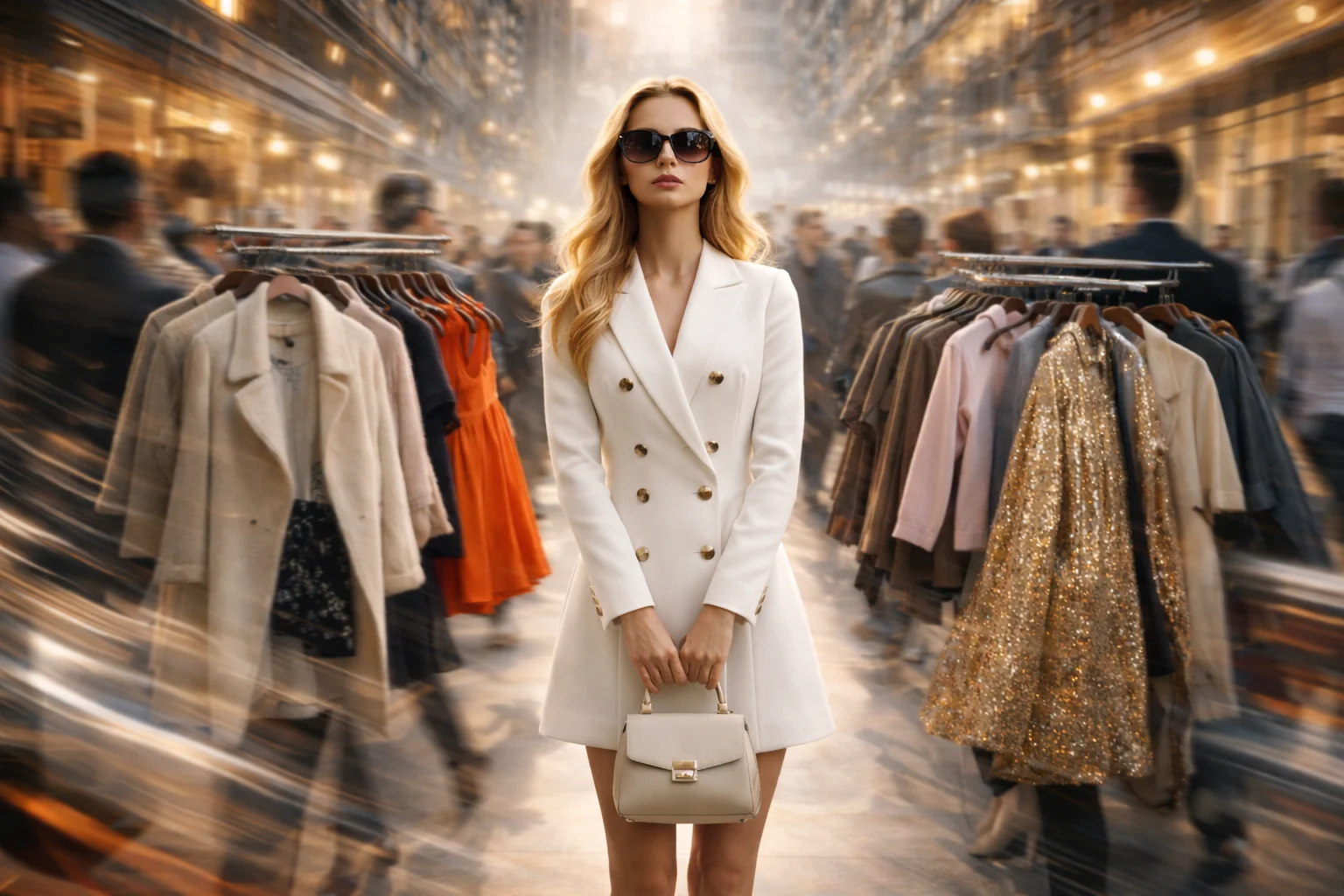
There was once a rhythm to fashion. A sense of anticipation that unfolded gradually, like the changing of light across a day. Fabrics grew heavier as the air cooled. Colors softened as the year drew inward. Nothing arrived without context. Nothing disappeared without memory. Fashion moved in conversation with time itself.
Today, that conversation feels fractured. Trends appear without origin and vanish without farewell. The continuity that once defined fashion has been replaced by interruption. Clothing no longer seems to belong to a moment. It exists in fragments, detached from the natural progression that once gave it meaning.
When Everything Happens at Once Nothing Lasts
Digital culture has collapsed the boundaries that once defined fashion’s pace. Seasons, once distinct and deliberate, now overlap until they lose distinction entirely. What was introduced weeks ago can already feel distant. What feels current today may appear irrelevant tomorrow.
This acceleration has altered perception. Fashion no longer signals where we are. It creates the impression that we are always in transition, never arriving.
There was comfort in the slower rhythm. It allowed individuals to absorb change gradually. To adapt without urgency. To develop familiarity with new silhouettes and textures before they shifted again.
Now, familiarity is interrupted before it can take hold.
Permanence Has Been Replaced by Momentum
Clothing once carried the weight of duration. Garments were designed with the expectation that they would remain present. They would be worn repeatedly, observed in different light, understood more deeply over time.
Today, clothing often exists in anticipation of replacement. Its relevance is assumed to be temporary. This assumption changes the way garments are experienced. They are no longer encountered as companions, but as intervals.
This shift has subtle psychological consequences. When clothing feels temporary, identity can begin to feel temporary alongside it. There is no stable visual foundation. Only movement.
The result is a quiet erosion of continuity.
The Body Still Moves at a Human Pace
While fashion has accelerated, the body has not. It still moves gradually. It still requires comfort, alignment, and familiarity. It still responds to fabric in deeply physical ways.
This creates a growing tension between the speed of fashion and the stability of the human form. Garments designed for immediacy do not always account for the experience of inhabiting them over time. They succeed visually, but not always physically.
Foundation garments and specialized underlayers have emerged as stabilizing elements within this unstable landscape. They create consistency beneath surfaces that change rapidly. Pieces such as sculpting bodysuits, seamless bases, and highly specific garments like trans lingerie exist within this broader ecosystem of precision construction, designed to provide continuity, support, and smoothness beneath outward expression. These garments function quietly, allowing the external silhouette to remain resolved even as trends shift around it.
They remind us that beneath fashion’s acceleration, the body remains constant.
Memory Once Lived Inside Clothing
Clothing was never purely visual. It was experiential. A coat carried the memory of winters past. A shirt softened in familiar places. Fabric adapted to posture, to movement, to repetition.
This accumulation of memory created depth. Garments became inseparable from the lives lived within them.
When clothing is replaced too quickly, this depth cannot form. There is no opportunity for adaptation. No opportunity for relationship.
Clothing becomes surface without history.
This absence of history creates a subtle disconnection. Without continuity, the wardrobe becomes a rotating sequence rather than a stable environment.
Fashion Without Time Becomes Image Alone
Fashion has always existed at the intersection of art and utility. It was meant to be seen, but also to be lived in. It was meant to evolve alongside the wearer.
When time is removed from this equation, fashion loses one of its essential dimensions. It becomes immediate, but not enduring. Visible, but not inhabitable.
The eye may remain satisfied, but the deeper experience is diminished.
There is a growing awareness of this imbalance. A recognition that speed alone cannot sustain meaning. That clothing requires duration to achieve significance.
Garments need time to become familiar. To become reliable. To become part of the architecture of identity.
Time Is the Element That Gives Fashion Meaning
Without time, fashion becomes weightless. It loses its ability to anchor. It loses its ability to reflect continuity.
But time has not disappeared entirely. It remains present in the garments that resist acceleration. In pieces that remain relevant not because they are new, but because they are resolved.
These garments do not demand replacement. They invite repetition. They deepen rather than expire.
They exist in alignment with the human experience of time, rather than in opposition to it.
Fashion has not lost its sense of time completely. But it has begun to forget it.
The question now is whether it will remember.

